

Before expanding your footprint, F&B owners must master systems and hospitality.
There is a familiar story in Vietnam’s restaurant scene.
A café opens with great coffee, a Korean restaurant becomes the neighbourhood favourite, or a family-owned eatery suddenly finds itself with queues outside every evening. Business is booming, so the next step seems obvious: open another branch.
Then reality arrives.
Costs climb faster than revenue. Service becomes inconsistent. Staff turnover increases. Cash flow tightens. The second location struggles to replicate the magic of the first.
For many businesses, the problem is not the food. It is scaling before building the right foundation.
Every successful F&B Owner eventually learns the same lesson: growth is not just about selling more meals. It is about creating systems that survive growth.
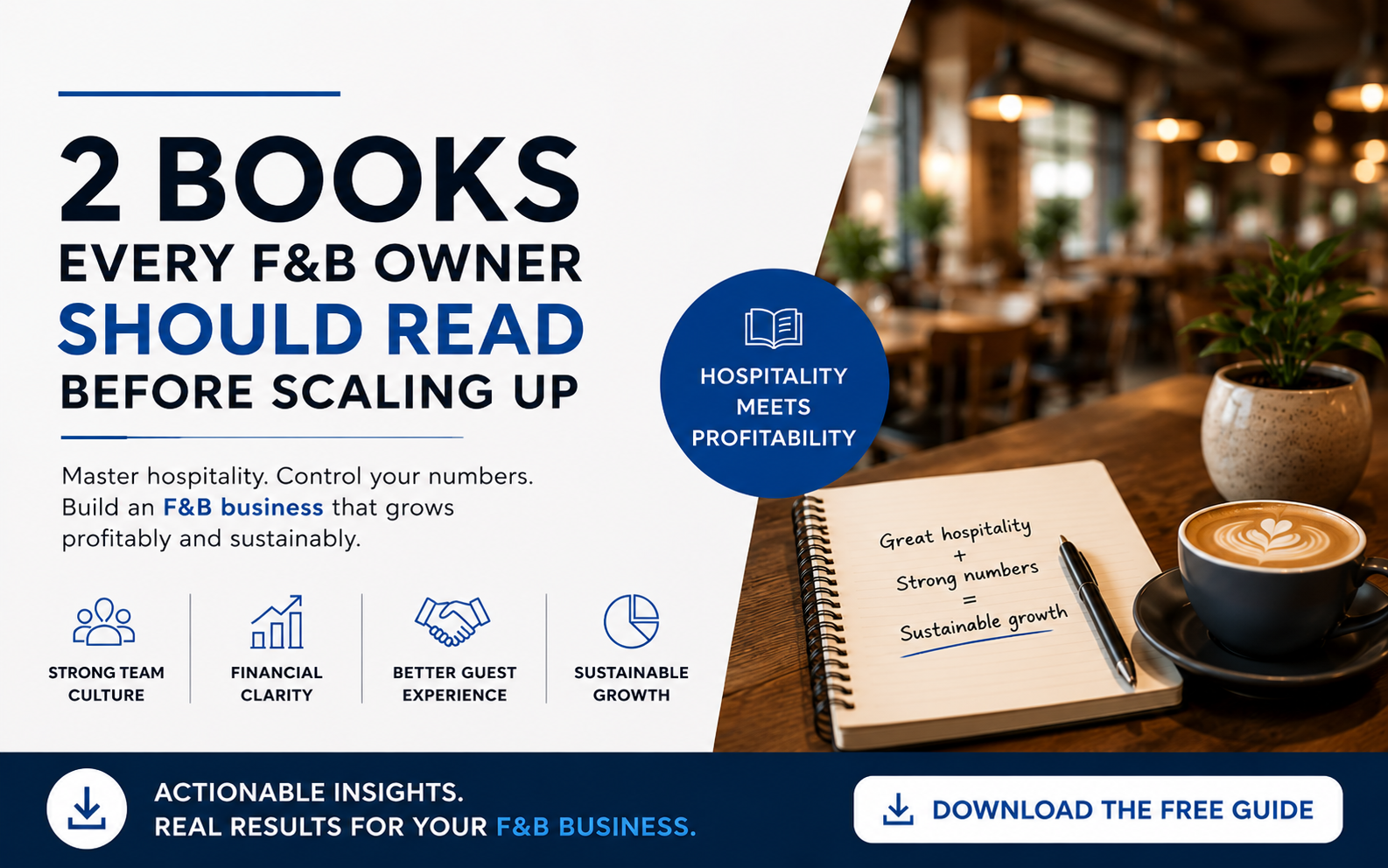
If there are two books worth reading before signing the lease for your next location, they are Setting the Table by Danny Meyer and Restaurant Success by the Numbers by Roger Fields.
Together, they offer something surprisingly rare: one teaches you how to build a restaurant people love, while the other teaches you how to build one that stays profitable.
Book One: Setting the Table — Hospitality Is Your Competitive Advantage
Danny Meyer did not build restaurants simply by serving exceptional food.
He built businesses people wanted to return to.
As the founder of Union Square Hospitality Group and the creator of the original Shake Shack, Meyer argues that restaurants are ultimately in the business of making people feel something.
That idea sounds simple, but it changes almost every business decision.
Hospitality Is Not the Same as Service
One of the most memorable lessons from the book is the distinction between service and hospitality.
Service is technical.
- The correct order
- Food served on time
- Clean tables
- Accurate billing
Hospitality is emotional.
It is remembering a regular customer’s favourite drink. It is noticing when a family is celebrating a birthday before they mention it. It is making guests feel that someone is genuinely on their side.
Many restaurants provide good service.
Far fewer create hospitality.
That difference is often why customers recommend one restaurant over another.
Employees Come Before Customers
This idea often surprises new business owners.
Most companies proudly claim that “the customer comes first”.
Danny Meyer disagrees.
Instead, he proposes what he calls Enlightened Hospitality.
His order of priorities is:
- Employees
- Guests
- Community
- Suppliers
- Investors
The reasoning is practical rather than idealistic.
People who feel respected, trusted and supported naturally provide better experiences for guests. Happy employees do not need to memorise scripts because genuine hospitality cannot be scripted.
For any F&B Owner managing multiple outlets, culture quickly becomes more valuable than any operations manual.
Hire Character Before Skills
Restaurants often recruit based on experience.
Meyer recommends something different.
His famous 51/49 rule suggests hiring 51% for emotional intelligence, attitude and curiosity, and only 49% for technical ability.
Cooking techniques can be taught.
Operating a POS system can be taught.
Teaching someone to genuinely care about another person is considerably harder.
For businesses preparing to expand, this hiring philosophy becomes increasingly important because culture spreads through people, not procedures.
Mistakes Can Create Loyal Customers
No restaurant is perfect.
Orders are forgotten.
Meals arrive late.
Reservations become mixed up.
The businesses customers remember are not those that never make mistakes—they are the ones that recover well.
A sincere apology, a thoughtful solution and a genuine desire to make things right often create stronger customer loyalty than a flawless visit ever could.
In hospitality, recovery is part of the experience.
Book Two: Restaurant Success by the Numbers — The Financial Reality Behind Every Restaurant
If Danny Meyer focuses on emotions, Roger Fields focuses on mathematics.
An accountant turned restaurant owner, Fields approaches restaurants from a refreshingly practical perspective.
His central argument is difficult to ignore:
Passion does not replace financial discipline.
A restaurant can be fully booked every weekend and still lose money.
Food Cost Is Not Just an Accounting Metric
Many owners know roughly what ingredients cost.
Few calculate food cost for every menu item.
Fields argues that every dish should be priced against a target food cost percentage—typically between 28% and 35%.
Without knowing this number, menu pricing becomes guesswork.
One bestseller with poor margins can quietly reduce profitability month after month.
For any growing F&B Owner, understanding food cost is as important as creating new menu items.
Know Your Break-Even Before Opening Another Branch
Expansion often feels exciting.
Numbers are less exciting.
Yet break-even calculations determine whether expansion becomes sustainable or stressful.
Before hiring more staff, increasing rent commitments or signing another lease, owners should know exactly how much monthly revenue the business needs simply to survive.
Growth without financial visibility is rarely sustainable.
Prime Cost Is the Number Worth Watching
Roger Fields introduces one metric every restaurant should monitor regularly:
Prime Cost = Food Cost + Labour Cost
Ideally, this combined figure should remain below 65% of total revenue.
Once it rises significantly above that level, profit margins begin shrinking rapidly.
Many businesses spend months chasing new customers while ignoring the operational costs quietly reducing profitability behind the scenes.
Cash Flow Matters More Than Profit
One of the book’s strongest reminders is that restaurants rarely fail because they lack profit on paper.
They fail because they run out of cash.
Rent cannot wait for next month’s revenue.
Suppliers cannot be paid with future profits.
Weekly cash flow reviews help owners identify problems before they become crises.
Why These Two Books Work Better Together
One book teaches leadership.
The other teaches financial discipline.
One focuses on people.
The other focuses on numbers.
Neither is enough on its own.
Restaurants built only around numbers often feel transactional.
Restaurants built only around passion often struggle financially.
The strongest businesses understand both.
That balance is particularly relevant in Vietnam’s competitive F&B landscape, where rising rents, fluctuating ingredient costs and increasing customer expectations leave little room for guesswork.
Lessons Every F&B Owner Can Apply This Week
You do not need to finish either book before making improvements.
Start with these practical actions:
- Calculate the food cost percentage for your five best-selling dishes.
- Write down your monthly break-even revenue.
- Review cash flow every Monday rather than every month.
- Interview future staff for attitude as much as experience.
- Create a simple complaint recovery process.
- Hold a 10-minute pre-shift briefing focused on hospitality, not just operations.
- Ask your ten most loyal customers why they keep coming back.
- Review your menu based on both popularity and profitability.
- Measure your prime cost every month.
- Set one hospitality goal your team can achieve this month.
Small operational habits often create bigger competitive advantages than expensive renovations or larger marketing budgets.
Final Thoughts
Every ambitious F&B Owner eventually reaches a crossroads.
One path is to keep working harder.
The other is to build a business that works smarter.
Setting the Table reminds us that restaurants are remembered because of how they make people feel.
Restaurant Success by the Numbers reminds us that memorable experiences still need healthy margins to survive.
Together, they offer something every growing restaurant needs: a blueprint for scaling without losing either culture or profitability.
Growth is not measured by how many branches you open.
It is measured by whether every new location feels just as welcoming—and performs just as sustainably—as the first.
Ready to Scale Your Restaurant with Confidence?
At Marketing Solutions Vietnam (MSVN), we work with cafés, restaurants and F&B brands across Vietnam to strengthen both brand presence and long-term growth. From marketing strategy and social media to customer experience and positioning, we help businesses build foundations that support sustainable expansion.
Whether you are opening your second location or preparing your fifth, the right strategy starts before the next lease is signed.
Talk to MSVN today and discover how strategic marketing can support your next stage of growth.
Download the Free Book Summary
Reading an entire business book takes time. Running a restaurant takes even more.
That is why the team at Marketing Solutions Vietnam (MSVN) has condensed the key lessons from Setting the Table by Danny Meyer and Restaurant Success by the Numbers by Roger Fields into a practical, easy-to-read guide designed for restaurant owners, café operators and hospitality businesses in Vietnam.
Inside, you will discover:
- Practical hospitality strategies you can implement immediately
- The financial metrics every F&B Owner should monitor
- A 10-point action checklist for improving your restaurant this week
- Real-world insights adapted for Vietnam’s competitive F&B market
📥 Download the FREE “2 Books Every F&B Owner Should Read Before Scaling Up” guide below and start building a business that is both memorable and profitable.
[Download Your Free Copy]